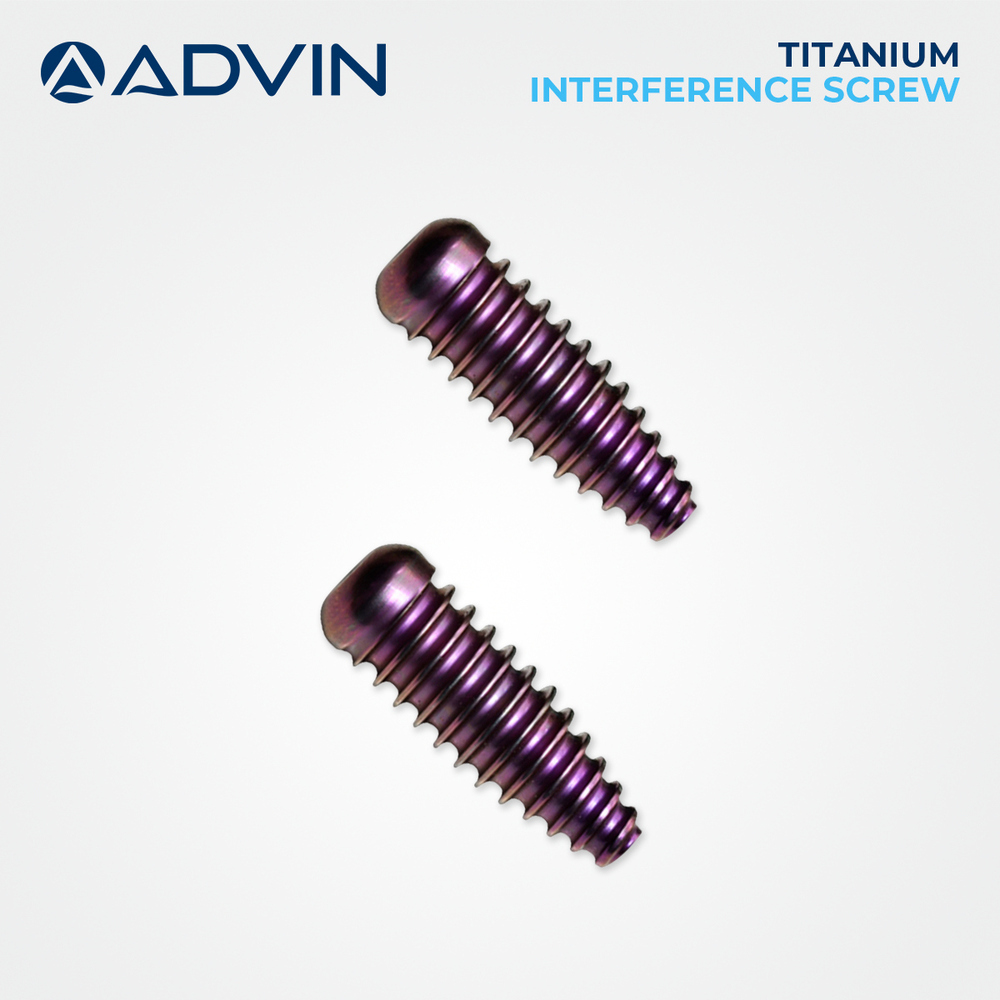
Titanium Interference Screw About
The Endo Button is extensively used in orthopedic surgery, particularly in the repair and rebuilding of the knee s anterior cruciate ligament (ACL). It is a non-traditional method of connecting grafts to bone during ACL restoration treatments.
Advanced Features
- Improved Fixation Strength
- Stress Reduction and Better Healing
- Technique with Minimal Invasion
- Widespread Use and Flexibility
- Patient Advantages and Better Outcomes
Advanced Fixation for Ligament ReconstructionThis interference screw is meticulously engineered for ACL and PCL reconstruction, offering reliable soft tissue graft fixation within the bone tunnel. Made from medical-grade titanium alloy, it ensures biocompatibility and long-lasting performance in demanding orthopedic procedures. Its self-tapping design allows for precise insertion and stable tension, contributing to positive surgical outcomes.
Versatile Design and User-Friendly PackagingAvailable in multiple sizes and threading directions (standard or reverse), the screw accommodates diverse surgical preferences and anatomical variations. Each screw comes individually sterilized via Ethylene Oxide (EO) and sealed in a sterile blister pack, facilitating easy identification and safe usage in operating theaters. Its lightweight, metallic silver finish, and compatibility with standard orthopedic instruments streamline surgical workflow.
FAQ's of Titanium Interference Screw:
Q: How is the Titanium Interference Screw sterilized before use?
A: The screw is ethylene oxide (EO) sterilized and individually packed in a sterile blister pack, ensuring it remains contamination-free until the moment of use.
Q: What surgical indications are suitable for this interference screw?
A: It is primarily indicated for use in ACL (anterior cruciate ligament), PCL (posterior cruciate ligament) and other soft tissue graft fixations, offering secure and reliable tendon anchoring during orthopedic surgery.
Q: When should this interference screw be used during a ligament reconstruction procedure?
A: This screw is used during the graft fixation phase of ligament reconstruction, securing the tendon or graft within the prepared bone tunnel for optimal stability and healing.
Q: Where can the Titanium Interference Screw be used?
A: It is designed for use in hospital and clinical settings equipped for orthopedic surgery, as it is compatible with standard orthopedic instrumentation and techniques.
Q: What are the benefits of using a titanium interference screw?
A: Benefits include high mechanical strength, superior biocompatibility, resistance to corrosion, precise placement via self-tapping design, MRI compatibility, and radiolucent markers for accurate imaging.
Q: How does the screw ensure compatibility with surgical instruments?
A: It is manufactured to standard orthopedic dimensions with options for hex or slotted heads, enabling seamless use with existing implant instrumentation.
Q: What are the storage and shelf-life recommendations for this product?
A: The screw should be stored in a clean, dry, sterile environment, and has a shelf life of 5 years when kept unopened in its original packaging.

 Send Inquiry



 Send Inquiry

 Send Inquiry
 English
 Spanish
 French
 German
 Italian
 Chinese (Simplified)
 Japanese
 Korean
 Arabic
 Portuguese